Feeds:
Posts
Comments

Archive for February, 2012

This loaf of cinnamon sugar bread almost never came to be, which would have been quite unfortunate, because it was a thing of perfection, with a crunchy top and soft interior laced with more than a mere hint of cinnamon sugar.

The first time I tried the recipe, the top wasn’t crunchy, and the interior was a wet, soupy messy of cinnamon sugar and raw batter. It fell apart coming out of the loaf pan, and I had to cut it into pieces before bringing it to the office to save myself the embarrassment of co-workers trying to cut/scoop servings for themselves.

The concoction’s only saving grace? It was, beneath the disfigured clumps and raw batter, utterly delicious.

The original recipe called for all of the cinnamon sugar mixture (a full 1/3 cup of sugar and 2 teaspoons of cinnamon) to be sprinkled in one layer on top of half of the batter, then topped with the rest of the batter. The cinnamon sugar mixture seems to have liquefied and prevented the batter immediately surrounding it from baking completely.

I decided to give the recipe one more chance, figuring that if I could make smaller layers of cinnamon sugar, maybe the batter would have a chance to cook more evenly.

I didn’t get the chance until this weekend, when I babysat my nieces while my sister-in-law had a much-deserved girls weekend out. Given my ineffective Barbie doll skills (the girls got pretty upset when I couldn’t remember the names of the dozen dolls NOT named Barbie) and the cold weather preventing us from easily pursuing outdoor, more tomboyish activities, I decided that a baking project was in order.

Part of the reason I wanted this recipe to work was its ease of preparation: You literally stir seven ingredients together for the batter and then layer it in the loaf pan with cinnamon sugar. No mixer. No sifting. No melting.

After having my charges stir the batter and shake the cinnamon sugar mixture together thoroughly, I poured what I figured to be about a third of the batter into the bottom of the greased and floured pan. I then had my nieces spoon about a third of the cinnamon sugar over the batter. I added another layer of batter, then almost all of the cinnamon sugar save for about 2 tablespoons. I added the rest of the batter, then sprinkled on the rest of the cinnamon sugar.

50 minutes in the oven plus 10 minutes on the wire rack and the loaf slid right out of the pan. After allowing the bread to cool for about 20 more minutes while watching Scooby-Doo (the 2002 live-action version), we had cinnamon bread and hot chocolate out of my childhood Tupperware tea set (now theirs).

Babysitting perfection.

The original recipe came from A Whisk and a Prayer via Pinterest.

Cinnamon Sugar Bread

Adapted from A Whisk and a Prayer

  • 1/3 cup white sugar
  • 2 teaspoons ground cinnamon
  • 2 cups all-purpose flour
  • 1 tablespoon baking powder
  • 1/2 teaspoon salt
  • 1 cup white sugar
  • 1 egg, beaten
  • 1 cup milk
  • 1/3 cup vegetable oil

Preheat oven to 350 degrees. Lightly grease a 9×5-inch inch loaf pan (I also cut a piece of parchment paper to fit on the bottom for extra non-stick protection). Stir the cinnamon and 1/3 cup sugar together.

In a large bowl, combine flour, baking powder, salt and 1 cup sugar. Add the egg, milk and oil. Stir until just moistened.

Pour approximately a third of the batter into the loaf pan. Sprinkle with about a third of the cinnamon sugar. Top with another third of the batter, then almost all of the remaining cinnamon sugar. Pour the rest of the batter in the pan and sprinkle the rest of the cinnamon sugar on top.

Bake in preheated oven for 45 to 50 minutes, or until a toothpick inserted into center of the loaf comes out clean. Let the bread cool in the pan for 10 minutes before removing it to a wire rack to cool completely.

The original recipe advises you to wrap the loaf in foil and let it sit overnight before slicing. If you can endure the scent of freshly baked cinnamon bread wafting through your home without cutting a piece off until the next day, then go for it. If not, enjoy your snack today AND tomorrow.
Read Full Post »

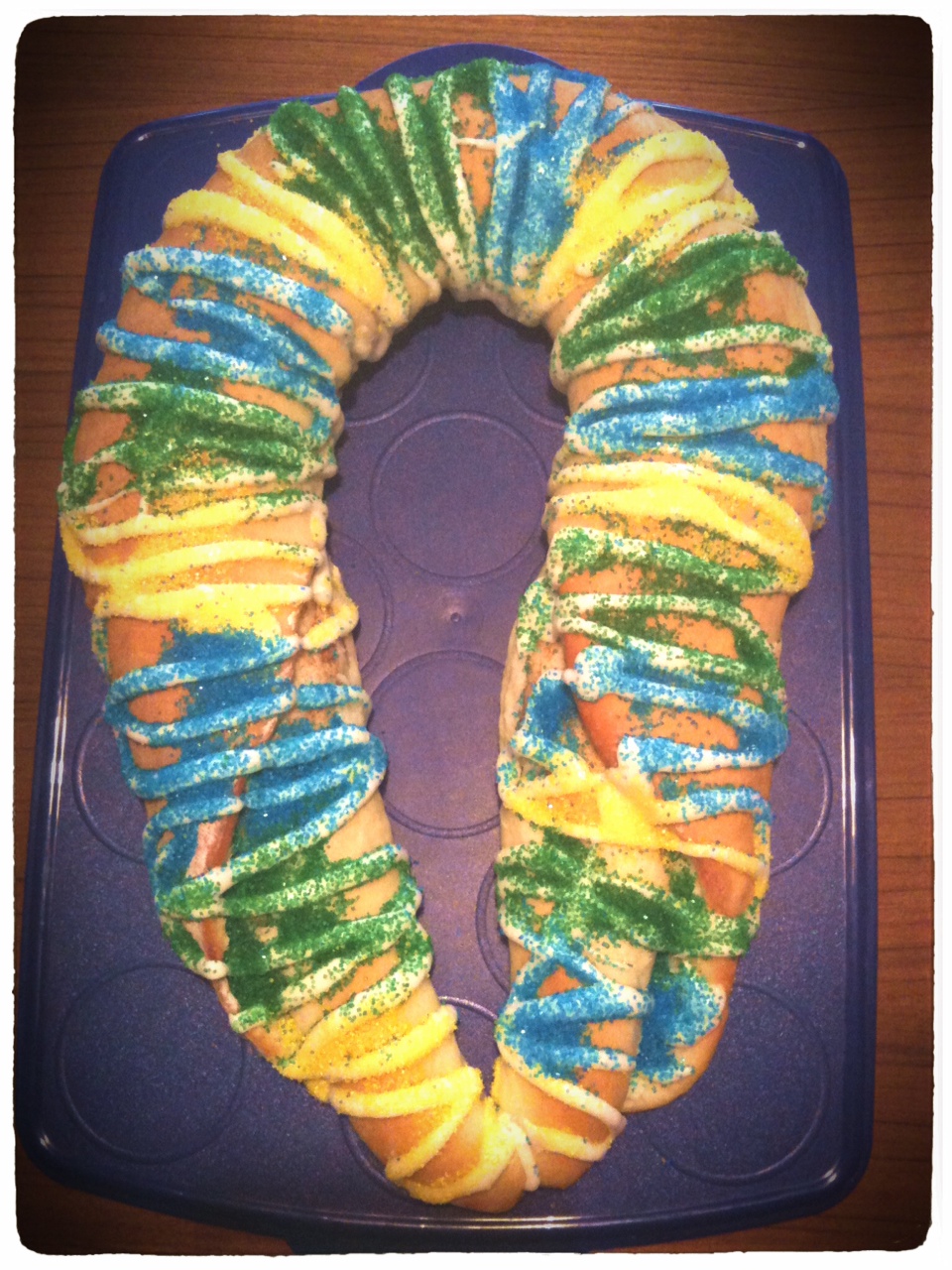
I gave up on finding an authentic, reasonably priced king cake in Huntsville this year. The king cakes at Publix have gone downhill since the days in which the bakery reportedly imported simple, unbaked cakes from Louisiana, baking and decorating them in the days leading up to Mardi Gras. This year, the offerings were filled with cream cheese in various artificial flavors, and I’m tired of bakeries trying to complicate the king cake. It’s SUPPOSED to be relatively simple. By the time you combine a thick, sweet filling with powdered sugar icing AND a heap of colored sugar on top, you’ve got a sickly sweet concoction that in no way resembles a traditional king cake.

Even Earth Fare got in on the act, promising me a king cake complete with apple filling.

No thanks.

After last year’s debacle with frozen bread dough, I decided to simply dedicate an afternoon to the old Southern Living recipe that my mom found some 20 years ago. It had been too long since the husband and I had enjoyed the real thing, and I had volunteered to make a king cake for my co-workers in lieu of suffering through some sort of monstrosity filled with artificially flavored goop.

I’m never convinced that I haven’t added too much flour in my efforts to make the dough manageable. My biggest complaint about this recipe is that it calls for flour by volume rather than weight; measuring flour using the scale is much more accurate than using measuring cups. The cake turned out fine, however, with both the husband and the co-workers giving it rave reviews.

I’d still give somebody $20 to make an acceptable king cake for me, but apparently I’m not going to be able to do that in Huntsville anytime soon.

King Cake

(Adapted from Southern Living)

Makes 2 cakes

  • ¼ cup butter
  • 1 (16-ounce) container sour cream
  • 1/3 cup sugar
  • 1 teaspoon salt
  • 2 (.25-ounce) envelopes active dry yeast
  • 1 tablespoon white sugar
  • ½ cup warm water (100 to 110 degrees)
  • 2 eggs
  • 6½ cups all-purpose flour, divided
  • ½ cup white sugar
  • 1½ teaspoons ground cinnamon
  • 1/3 cup butter or margarine, softened
  • Frosting (see below)
  • Colored sugars (see below)

Cook the first four ingredients in a saucepan over low heat, stirring often, until the butter melts. Cool the mixture to between 100 and 110 degrees.

Dissolve the yeast and 1 tablespoon sugar in ½ cup warm water in a large bowl; let stand 5 minutes. Add the butter mixture, eggs and 2 cups flour; beat at medium speed with an electric mixer for 2 minutes or until smooth.

Gradually stir in enough remaining flour to make a soft dough.

Turn dough onto a lightly floured surface; knead until smooth and elastic, about 10 minutes. Place in a well-greased bowl, turning to grease the top. Cover and let rise in a warm place (85 degrees), free from drafts for 1 hour or until doubled in bulk.

Stir together ½ cup sugar and cinnamon; set aside. Punch dough down; divide in half. Turn one portion out onto a lightly floured surface; roll to a 28-x-10-inch rectangle.

Spread half each of the cinnamon mixture and the softened butter on the dough. Roll the dough, jellyroll fashion, starting at the long side. Place the dough roll, seam side down, on a lightly greased baking sheet.

Bring the ends together to form an oval ring, moistening and pinching the edges together to seal. Repeat with remaining dough, cinnamon mixture and butter.

Bake at 375 degrees for 15 minutes or until golden. Decorate with bands of frosting, and sprinkle with colored sugars.

Note: This year, I spooned the frosting into a zip-top bag, cut off a corner and squeezed the frosting onto the cake. This gave me a much neater, more even application than I would have gotten by simply drizzling it on the cake. Also, sprinkling the sugar on top will make a HUGE mess. You’re going to want to sprinkle the sugar on the king cake far away from the edge of the countertop or table so you don’t get sugar on the floor. Moisten a couple of dish towels with water and place them on the surface beneath the cake platter (cookie sheet, whatever) that’ll be holding the cake as you sprinkle on the sugar.

Frosting

  • 3 cups powdered sugar
  • 3 tablespoons butter, melted
  • 3 tablespoons milk
  • ¼ teaspoon vanilla extract

Stir together powdered sugar and melted butter. Add milk to reach desired consistency for drizzling; stir in vanilla.

Note: The original recipe advises you to divide the frosting and tint it green, yellow and purple, but since you’re going to coat it with colored sugar anyway, you’ll do just as well to leave it white.

Colored Sugars

  • 1½ cups white sugar, divided
  • 2 drops green food color
  • 2 drops yellow food coloring
  • 2 drops red food color
  • 2 drops blue food coloring

Place ½ cup sugar and green food coloring in a jar or zip-top plastic bag; seal.

Shake vigorously to evenly mix color with sugar. Repeat procedure with ½ cup sugar and yellow food coloring.

For purple, combine red and blue food coloring before adding to remaining ½ cup sugar.

Note: A couple of years ago, I discovered that Wal-Mart made much prettier, more vividly colored sugar than I could. My colored sugar was always paler than the sugar I saw in bakeries, and it was decidedly non-sparkly. You might have to use blue instead of purple, but you’ll live.

Read Full Post »

I’ll forever be thankful to my mother-in-law for introducing me to the easiest appetizer I’ve ever served: marinated artichoke hearts.

You’re probably thinking, wow, isn’t it kind of tricky to trim artichokes? And wouldn’t you have to marinate them for a few hours before serving? Wait a minute, wouldn’t you have to cook them, too?

The answer to all of those questions is “yes.” Which is why I simply open a jar of Vigo’s marinated artichoke hearts and carve them up into bite-size pieces, which I then serve with the fanciest crackers I can dig out of the pantry. (Why Vigo? It’s in stock. There aren’t exactly dozens of brands on the supermarket shelves vying for my business.)

After all, if I’m serving a meal that’s elaborate enough to justify an appetizer, chances are I’ve already spent a couple of hours in the kitchen prepping the other dishes. This is one culinary shortcut that I find completely acceptable.

And best of all? If it’s just me and the husband, they’re mine. All mine. Leftovers get chopped up into even smaller pieces to use as a salad ingredient throughout the week, and the marinade itself makes a delicious (if somewhat thick and rich) salad dressing.

Read Full Post »

Rarely do I give a failed Internet-based recipe a second chance. There are simply too many other recipes to try, and unless I can point to something I know I did wrong (it happens), I’ll usually just write off such failures as lessons learned.

Roasted chickpeas, though? I WANTED the roasted chickpeas to work. So when the first batch came out half-crunchy and half-mushy a couple of weeks ago, I knew I had to try again. The few (very few) roasted chickpeas that were roasted to perfection were ROASTED TO PERFECTION. They were tiny, crunchy bombs of flavor.

I found two problems with my first attempt:

  1. The original recipe called for what seems like A LOT of olive oil: 1.5 tablespoons for one can of chickpeas. I was left with oil oozing around on the parchment paper beneath the coated chickpeas.
  2. My oven can be somewhat unpredictable. It will bake three tiny loaves of zucchini bread to utter perfection within the recommended recipe time, or it will take twice as long as it should to bake a pan of cookies. And sometimes it’ll burn those cookies on the bottom without leaving a hint of gold on their pale little tops.

So, less olive oil and more time in the oven seemed to be in order. Also, I decided to add the seasoning BEFORE roasting, since, in theory, perfectly roasted chickpeas would be dry to the touch and wouldn’t allow the seasonings to stick.

A word on the seasonings: You can use anything you like. I used Tony Chachere’s Original Creole Seasoning. I’m not sure why you would use anything else, but I imagine Greek seasoning would also work. Crafty Kristen recommends a teaspoon or two of cracked black pepper and a generous sprinkling of sea salt.

This batch turned out perfectly — even the biggest chickpeas roasted to crunchy perfection.

Crispy Roasted Chickpeas

Adapted from Steamy Kitchen

  • One 15-oz. can chickpeas
  • Olive oil
  • Salt/seasoning mixture

Preheat the oven to 400 degrees (I might go up 25 degrees next time).

Drain the chickpeas in a colander and rinse with water. Rub the chickpeas, a couple of handfuls at a time, between two paper towels to loosen the thin skin on them. Remove the skins until you get tired of removing the skins, then move on. Your roasted chickpeas will be delightful with or without the skins.

Spread a piece of parchment paper out on a baking sheet. Or don’t — hey, I’m not washing your dishes. Spread the chickpeas out on the parchment paper. Put a little olive oil in your hands and coat the chickpeas lightly — you want just enough oil to allow the seasoning to stick. Sprinkle on the seasoning. Less is likely more.

Steamy Kitchen’s original recipe said to roast the chickpeas for 30-40 minutes, but my oven took more like 50 minutes. Stir them around about halfway through. The chickpeas will turn a deep golden brown when they’re done, but the best way to check for doneness is to grab one of the bigger ones, cool it off for 30 seconds and eat it. If it’s crunchy, you’re in business.

Read Full Post »

Why in the world have I NOT been making guacamole all my life?

The answer, of course, is that I spent most of my life eating (or, more specifically, not eating) the mediocre guacamole served in so many Mexican restaurants.

Overprocessed into a perfectly smooth paste and refrigerated well past the point of freshness, restaurant guacamole has always been something I avoided. I never ordered it, and never considered making it at home.

Thankfully, a restaurant finally changed my mind on guacamole a couple of years ago. When a friend ordered the dish at Cantina Laredo, the server made it tableside, mashing several fresh ingredients together with a fork. It was delicious. It was chunky. It was FRESH.

I thought maybe it was only my taste buds maturing, so in a couple of weeks I tried the guacamole at another Mexican place.  Nope. Back to stale and pasty. I realized that unless I witnessed the smashing of the avocados, the guacamole was likely to disappoint.

Still, I didn’t attempt to make my own. The husband wasn’t enthusiastic about the dish, and, having never dealt with avocados before, I was a little awed by the process.

Fast forward to last week. Somehow, guacamole is an official Super Bowl food, and Earth Fare was offering me two free avocados with a $5 purchase.

Please. I can spend $5 in Earth Fare without ever leaving the Wall o’ Grains.

I looked for a simple recipe, although now I realize that guacamole, like pico de gallo, is one of those dishes that doesn’t require a recipe so much as a healthy willingness to taste as you go. (Check.)

I settled on the California Avocado Commission’s recipe for Guacamole Autentico, which seemed beginner-worthy. It was a cinch to put together (turns out it’s extremely easy to work with avocados), and I thought it was delicious (the husband is still not a guacamole fan, although he readily ate a couple of bites to be nice).

Lime and cilantro are dominant flavors in this recipe, and not everybody likes cilantro. I would probably use two Serrano chilies instead of one next time for more heat, or I might just switch to a jalapeno. And I could totally live without the tasteless bits of Roma tomato, but a REAL tomato may have potential. I forgot to add hot pepper sauce, and I used plain old salt and pepper instead of sea salt and white pepper — still delicious. I mashed it all together with a potato masher, not a fork, because I was hungry and the fork method was taking forever. Just don’t get too overzealous with the mashing no matter what you use.

Guacamole Autentico

Recipe from the California Avocado Commission

4 servings

  • 2 ripe, fresh California avocados, peeled and seeded
  • 1⁄4 tsp. ground cumin
  • 1⁄2 ripe, medium Roma tomato, seeded and diced
  • 1⁄4 cup minced sweet white onion
  • 1 Serrano chili, seeded and minced
  • 1⁄4 cup cilantro leaves, chopped
  • 2 Tbsp. fresh lime juice
  • Hot pepper sauce
  • Sea salt, to taste
  • White pepper, to taste

Cut avocado into large chunks and mash coarsely in large bowl with a fork. Add remaining ingredients and blend gently; leaving some small chunks is fine. Taste and adjust seasoning with more pepper sauce, salt and pepper if desired.

Serve immediately. Eat with enthusiasm.

Read Full Post »

I always thought I hated running, for one good reason (although maybe it counts as two): boobs.

I was on the girl’s basketball team in seventh grade, which also happened to be the year that my breasts started sprouting in earnest. Sports bras weren’t a thing yet in the ’80s … boobs bouncing down the court were just part of the scenery of practices and games (the Lady Hawks included eighth- and ninth-graders in all stages of development). I wasn’t comfortable with the bouncing itself or spectators watching the bouncing, however.

And the utter stupidity of being called the Lady Hawks: DON’T EVEN GET ME STARTED.

When sports bras began to become more popular in the ’90s, they still weren’t worth much for ladies with anything bigger than B cups. (And don’t think I’m bragging until YOU try to fit them into an Ann Taylor blouse that isn’t so big the shoulder seams are drooping toward your elbows or so tight that the top button is threatening to put someone’s eye out.)

I tried the double-down trick for aerobics classes (SHUT UP) in college, but wearing two sports bras at once pretty much doubles the amount of boob sweat you produce in half the time.

I made peace with the non-bouncy elliptical machine for a few years, then discovered weight training, which I simply LOVED. My body responded quickly, toning here, putting on a little bit of muscle there. Best of all, I didn’t feel skinny or fat, just STRONG.

Even the most effective fitness programs become ruts after a while, however. Bored with weights and walking and the occasional foray into the neighborhood gym (and vividly aware that my cardio stamina was rapidly diminishing), I signed up for Madison Adventure Boot Camp in November.

Finally, I had a reason (and marching orders from Joe Martin, boot camp owner and official trainer of the Rocket City Bloggers) to buy one of those pricey new and improved sports bras that I had read so much about the past few years — a Moving Comfort model from Fleet Feet, which carries a huge variety of bras in a tiny display area and will let you try them ALL on if you need to.

We ran in boot camp, and ran some more. I almost hurt myself — luckily, my shin splints turned out to be less splinty than some — but I discovered that, with the bouncing problem solved, running not only wouldn’t kill me, it could actually be fun.

I’m not the best runner in the world, mind you. I stop to pet dogs. I slow down so I don’t scare ducks. Sometimes I slow to a stroll, convinced that I’m going to die on the street of a heart explosion like a 1985 cocaine addict with really bad judgement.

But then I start running again. One more sidewalk segment. Then another. To the end of that row of hedges. No, wait. THAT row of hedges. I shave two minutes off my route and think, next week, another two minutes is coming off.

Running makes me feel like I can do anything, as long as I can find the right bra and stop to pet dogs. ANYTHING. And that feeling is worth a LOT of $50 sports bras.


Read Full Post »
