Feeds:
Posts
Comments

How weird to be in the middle of a food trend and not realize it.

I’ve been trying to reduce the amount of processed food in my family’s diet for the past few years. I was unemployed for a few months when we first moved to Huntsville, so I started cooking a lot to try to save money and fill time. And not Hamburger Helper-type cooking, either. I’m talking from-scratch cooking, as in grate your own cheese (melts so much better than pre-shredded) and making your own meatloaf spice mixture (because have you READ the ingredients on those little flavoring packets?). The salad spinner became a permanent resident in the fridge, always filled with fresh (and local, when available) greens.

We didn’t give up EVERY processed food, mind you. There may or may not be a multipack of frozen pizzas from Costco in my freezer right now. The peanut butter that the husband eats every day is incredibly hydrogenated (I’d go bankrupt trying to feed him the real stuff). I don’t make my own mayonnaise, although I should make my own salad dressing.

So I’m not claiming that we’re dietary saints. But we’ve both maintained our weight for the past five years despite some substantial lapses in workouts, and we’ve put a significant dent in the number of colds and other odd viruses that haunt so many households. Coincidence? Maybe, but I’ll take it.

We find ourselves in the middle of the Real Food Movement. Come on in. It’s delicious.

I rescued a copy of The End of Overeating: Taking Control of the Insatiable American Appetite from my mom’s Goodwill box a few months ago and just got around to reading it. Author David A. Kessler explores, among other things, how utterly processed the average American diet is. The food industry exists to sell us cheaply manufactured goods that make us want to eat more, no matter how much sugar, fat and salt it takes to get us hooked.

I spotted a title at Barnes & Noble this weekend that actually distracted me from the Harry Potter table: Skinny Chicks Eat Real Food: Kick Your Fake Food Habit, Kickstart Your Weight Loss. Author Christine Avanti explores factory food addiction and how her move to fresh, real foods helped her lose weight and, more importantly, maintain her weight. I didn’t pick up the book because, I told myself, I’m not trying to lose weight OR fill up my bookshelves right now, but I’m very curious to read Avanti’s findings.

The thing about (who knew?) being part of the Real Food Movement for the past couple of years? I can now often taste the difference between processed foods and real foods. For example, I can taste the excessive sugar in jars of spaghetti sauce — there’s only one variety I can really stand to eat now, and the husband’s not fond of it. The flavor of salt in canned soup is getting overwhelming — heck, I can taste salt in one variety of CHEESE now, prompting me to replace it with another.

So, as anticlimactic as it may be, my New Year’s Resolution is to keep following the Real Food path. I’ll also be changing up my exercise routine (more on that later), but mostly I’ll continue figuring out how to feed the husband and myself quality, delicious foods and get further away from the “better living through chemistry” theme that has overtaken our food industry for the past few decades.

To that end, I’m afraid the pantry is about to lose two longstanding residents. You’ve been handy, jarred spaghetti sauce and canned soup, but I can taste your additives, and I can make you better without them.

Not that I’ve spent my life in search of the perfect Bloody Mary, but I found it at the Todd English P.U.B. in Vegas.

A mix of tomato juice, horseradish root, sriracha sauce and olive juice, Todd’s Sssinful Bloody Mary had the perfect amount of kick to it. Meaning that it’ll be too spicy for some people.

The few Bloody Marys that I have consumed inevitably got their spiciness from a dash of Tabasco sauce. The flavor never made me come back for more, perhaps because Tabasco is the go-to hot sauce of the Gulf Coast and the flavor simply begins to blend into the background after a while.

The sriracha sauce (better known as rooster sauce to many fans) in this concoction, however, gave it a bold, unapologetic heat that I am compelled to try to reproduce. I haven’t been able to find any Todd English-specific Bloody Mary recipes, so I’m going to start with the Sriracha Bloody Mary Recipe published on the White on Rice Couple blog.

Since the Bloody Mary is, after all, a breakfast drink, I ordered a brunch dish to go with it: corned beef hash, poached eggs on toast and asparagus. (Full disclosure: I ordered the brunch mostly because it came with the Bloody Mary, which would have cost $15 by itself. For only $7 more, I got food too — a bargain basement price on the Strip.)

Delicious. The eggs were poached to perfection (again, compelling me to tell myself that I should really learn to poach eggs), and the corned beef was surprisingly delicious. Apparently, the corned beef that I had several times as a teenager, which was so overseasoned that it almost made me gag, is NOT the norm.

Even the asparagus was delicious. (And I say “even” as if properly cooked asparagus isn’t one of the tastiest things ever.)

I will test and update. In the meantime, if you have any tips on making an awesome Bloody Mary, send them my way.

And be sure to check out The Oatmeal cartoon illustrating the glory that is sriracha sauce.

Two years ago, I completed a successful search for a recipe that tasted like the fabulous Gingeroos that I bought at a Las Vegas Trader Joe’s but couldn’t find in Nashville.

The husband and I spent Christmas in Vegas this year, and when I spotted the bags of Gingeroos on the shelf at TJ’s, I knew it was the perfect time for a taste test since we had just polished off the last of this year’s Triple Ginger Cookies a couple of days earlier.

The verdict? My cookies are actually BETTER than Gingeroos. Either I originally gave these cookies more props than they deserved, or the recipe has changed over the last three years. They were lighter than I remembered, more like a basic gingerbread than the spicy cookies I’ve been making. The big chunks of candied ginger that I recalled simply weren’t there.

Don’t get me wrong: Gingeroos are still one of my favorite store-bought cookies (granted, this is not a long list). They served as a delicious impromptu hotel snack and got us through the last 30 minutes of a long flight home.

The revelation that they’re not the best cookies in the world, however, has made me realize that I not only can make foods that are just as good as store-bought, I can make them BETTER.

End-of-the-year ego boost? I’ll take it.

I participated in a virtual cookie swap earlier this week hosted by Kat over at She Cooks, He Eats. I can tell you from experience that this swap was a lot less stressful than a real-life cookie swap.  Kat only wanted links, photos and recipes, whereas the real-life cookie swap hostess actually made us bring cookies.

Kat offers delicious-looking recipes for everything from versatile shortbread cookies to peppermint brownies, all submitted by a variety of bloggers. Recipes from Entirely Adequate include my favorite treat, spicy Triple Ginger Cookies, and the troublesome-to-make but scrumptious Glittering Lemon Sandwich Cookies.

Head over to the swap and check out all the recipes if you’re looking for a new holiday baking project.

Literally, the minute that I was supposed to be leaving for graduation last week (which was literally about 10 minutes after I was really supposed to be leaving), it struck me how sad it was that my dad wasn’t going to get to see me walk across the stage for my master’s degree.

(It was also sad that my mom couldn’t come to graduation, but as the parent who did not die in 2002, she’s still at a decided advantage in the current activities department.)

I’m not one to wallow in melancholy, however, especially when I’m busy, so I quickly formulated a fix: I would wear something that belonged to Dad, sort of in memoriam, sort of as a good-luck/don’t-trip charm.

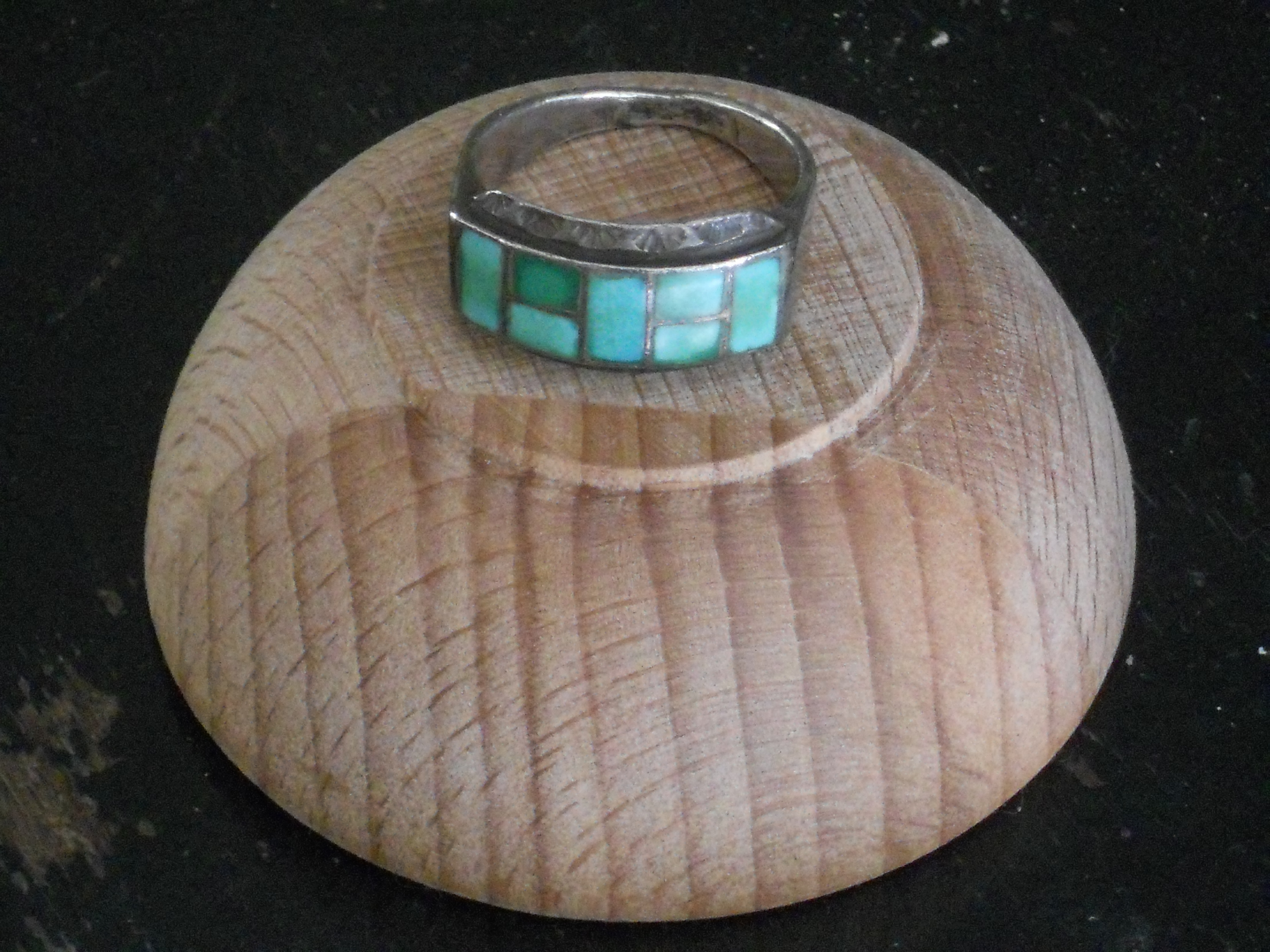
I had his old college class ring, his wedding ring and a turquoise ring, pictured above, that I had given him when I was in college the first time around.

The class ring is huge, heavy and just plain cumbersome. And toting around a wedding ring from a divorced man seems a tad unlucky.

Turquoise it was. Only my dad was a big, burly sort, and this ring didn’t even fit on my thumb. I pictured it flying off my hand when I was midway across the stage before noisily rolling an embarrassingly long way under the assembled chairs.

So I was all, OK, I’ll put it on a chain around my neck. But my necklace supply is meager, and a quick dig through the jewelry box yielded nothing suitable.

Time was getting on. I did a mental check of everything I was wearing. No pockets.

The only contender: my watch. I quickly unlatched it, slid the ring onto the band and latched it back into place.

All of this took place in the span of about 30 seconds.

That’s how I took a little piece of my dad across the stage with me. And I didn’t stumble, although I did almost get my crazy-wide gown arm caught on the metal railing around the stage.

Afterwards, I texted mom a couple of photographs. It all felt sort of balanced, parent-wise.

Sometimes it’s best to just go with a crazy urge, especially if you’ve only got one shot at it. Better to do something now that may seem a little kooky than to later regret not doing it.

I have purchased no eggnog this year.

Normally, I would be on my second carton by now.

When I first spotted cartons of eggnog in the dairy aisle a few weeks ago, however, it just didn’t seem worth the calories.

Part of this attitude, admittedly, results from attending boot camp at 5:30 a.m. three days a week. I’m not negating that much hard work with 6 ounces of sugar and fat.

Part of it, though, is the realization that eggnog is simply a nostalgic food for me, a trip back in time to childhood.

When I was a child, eggnog was something that I drank only at my grandparents’ house, and only in the days leading up to Christmas. We drank it out of these fabulous Santa mugs:

As my friends Kristen and Harold have noted, however, nostalgia can be burdensome. I can’t re-create those Christmas scenes, and I shouldn’t want to. Every day of the year gives us another chance to create NEW memories. Trying to redo the past, even the little pieces of it, can only lead to bitterness and disappointment.

My brother’s kids are going to remember that Tia always made red velvet cake pops for them at Christmas, and Tia’s going to remind them that, for little girls under 50 lbs., they ate an impressive number of the rich morsels. And in 20 years or so, I hope they come up with their very own tradition, leaving cake pops in the dust if that’s not really their thing anymore.

I’ll give them the Santa mugs, though, if they decide that eggnog is their thing.

Stories trump stuff

I thought this was interesting in light of my recent post on aspirational clutter. While blogger jlsathre had assumed that she would end up bringing home most of the contents of her deceased parents’ house when she and her sister cleaned it out, she left with only a very few items.

In The Things I Didn’t Keep of Mom and Dad’s, she writes:

Leaving the house that first day, I knew that it wasn’t the things that remained inside that I wanted to keep. I did take a few things– the candy dish, a ledger with page after page of Dad’s handwriting, and an address book with pages of Mom’s.  But mainly what I kept  were things I didn’t have to carry.  I had found that I didn’t need very much.  I already had the stories.

Stories without things? Absolutely the best souvenirs you can ask for.

Things without stories? They’ll clog your closets and your mind.

Not every item that we inherit has a story, and I think it’s an unfair burden to think that we have to keep a thing only because it belonged to someone in particular.

Stories vs. things? I’m picking stories every time.

Boot Camp: Shin chagrin

The wages of exuberance: shin splints.

I’m not actually willing to call them shin splints yet, however. Let’s just call them shin irritations.

I knew I was in trouble when I took the elevator to the second floor this morning and then couldn’t work up the energy to go try on boots at lunch.

BOOTS, people. Cute ones. On SALE.

Fine. I overdid it Wednesday morning, when I discovered mid-run that I could run farther than I could in previous sessions. So, like the Flock of Seagulls, I ran so far away, walked a little, then ran a little more. UPHILL.

I ran too far for my own good, apparently.

I’ve taken the elevator and a couple of anti-inflammatories. I’ll ice my lower legs tonight. I’ll pace myself at tomorrow morning’s boot camp.

The fact that I haven’t even considered skipping it means that one correct description for me is either resolute or hard-headed. Maybe both.

Everybody’s got something to say about the holidays.

As Christmas nears, even the most thick-skinned writers seem to get the nostalgia bug. Some of us simply enjoy the sheer culinary freedom afforded by the season’s party circuit and feel compelled to share their kitchen adventures (cake pops and glittering lemon sandwich cookies are among the festive holiday treats that I urge you to attempt). Others share photos of their sparkling decor, or memories of craftiness gone wrong.

You can find a little bit of everything holiday from some of the best writers in Huntsville in the fifth edition of the Rocket City Bloggers Carnival:

Have you ever found a book passage that seemed custom-written for you?

While perusing Slave to Happiness: Why Having an Interesting Life is the New American Dream by Penelope Trunk, I stumbled over this paragraph in the chapter titled “Testing the Meaning of Money and the Value of Stuff”:

So much of what we human beings hold on to is what we wish we were using — aspirational clutter. Objects that commemorate a life we aspire to but do not have.

I’ve had a version of this thought running around in my head for the past two weeks. I’ve expressed my exasperation to the husband that sometimes it feels like our house is simply a museum for stuff, a storage bin for the trappings of suburban life.

There’s a reason they’re called trappings: Get yourself a houseful of stuff and see how much it stresses you out to even CONSIDER packing it all up to move.

We all seem to find ourselves using the “what if” mentality when it comes to belongings. What if I ever have 12 people over for a sit-down dinner? (Note: If I invite 12 people over for a sit-down dinner, call your local psychiatrist because, seriously, 12 people?) What if I decide to take up embroidery again, despite the fact that the activity bored me to no end the first time? What if I decide to make homemade Twinkies with that specialty pan, despite the fact that the only homemade Twinkies I ever made were nearly as atrocious as the real thing?

What if I never saw this stuff again?

People attach artificial value to a lot of things they never use and really wouldn’t miss if they were gone.

We’ve essentially made ourselves immobile. Scale up in home size, scale up in things to fill it. And I don’t mean Hoarders amounts of stuff, I mean bookshelves filled from end to end, cabinets filled with things that rarely see use and plastic boxes — neatly stacked in closets, mind you — filled with decorations and accessories that we’ve either tired of (for now, we tell ourselves) or just don’t work in our current situation (for example, we haven’t had a Christmas tree in 15 years because of the cats, but we do have a box filled with lights and a few ornaments because, you know, one day …).

The funny thing? That rare moment when you DO find that you need the stitch-puller that you remember packing away with the rest of the sewing supplies even though you never sew? You WILL NOT be able to find it because of all the other stuff you’ve got neatly stored, just in case you ever need it.

It’s lunacy, really, the way we stockpile our homes and clutter our lives and minds with physical objects that have little use or meaning. We trap ourselves in suburbia with 2,000 square feet of china cabinets, storage ottomans and under-the-bed sweater boxes, never considering the opportunities we might freely pursue if we didn’t have to worry about the stuff spread all over the house, the tiny apartment in the big city we might move to if we only didn’t have hundreds of books and an inexplicable assortment of old, unused electronics.

Maybe it’s time to refocus our aspirations so that our “aspirational clutter” isn’t clutter at all, but only the things we use, love and enjoy.