Feeds:
Posts
Comments

If I’m not planning my vacation around doughnuts, then you can bet that I’ve got my eye on a good ice cream place or two. Jake’s Ice Cream in Atlanta, for example, or the Shake Shack in Manhattan (actually, TONS of ice cream places in Manhattan — I never have enough time to visit all the places on my list and they just keep opening) — you name a city, I’ll find an ice cream place that you should try.

I had been trying to get to the Pied Piper Creamery in Nashville for a couple of years now, but always seemed to be in a rush to return home or to get somewhere else in Nashville, which, BTW, has topped Atlanta as my least-favorite city to drive around in. We never seemed to make it to the right part of town, which is a shame because East Nashville’s Five Points District is really awesome, and possibly my favorite part of Nashville given its lack of the touristy junk that pervades downtown.

Back to ice cream. After a quick lunch at the 3 Crow Bar (which turned a simple BLT into an unforgettable BLTEA with the addition of sliced boiled eggs and avocado), we took a detour before heading back to the car. Half a block down, I spotted the Pied Piper Creamery and I’m pretty sure I stopped, gasped and pointed. I was a little full for ice cream, but I WAS NOT about to miss out on this surprise discovery.

The husband agreed to split a small cup with me. This upped the pressure, since I could choose only ONE flavor.

I passed up the ever-famous Trailer Trash (vanilla with Oreo, Twix, Butterfinger, Nestle Crunch, Snickers, M&Ms, and Reese’s Pieces). I managed to avoid the siren call of the weird flavors, such as We Can Pickle That (dill pickle sorbet). I didn’t want to go too pedestrian, however, and I had been craving banana pudding since reading about Miss Lily’s Banana Pudding last week, so I chose the Banana Fanna Fo Fudding (banana pudding ice cream with vanilla wafers).

It was exquisitely creamy, filled with just the right ratio of bananas to vanilla wafers. Both the bananas and wafers held their textures well, especially considering the tendency of bananas to get slimy and wafers to get soggy when immersed in pudding. The banana flavor was distinct, but it was definitely not the overwhelming artificial banana flavor found in so many fruit-flavored foods.

The small cup was about $2.50, and it would have been enough for one person had that one person not just eaten a BLTEA wrap and a small bag of kettle chips all by herself.

I’m already planning my return trip, because sometimes the Pied Piper Creamery has a flavor called Ziggy Starcrunch (chocolate with Little Debbie Star Crunch pieces and a caramel swirl), and if you talk with me about food for more than 15 minutes you’ll probably find out why I call myself the Forrest Gump of Little Debbie products and you’ll also know why I simply have to try this flavor.
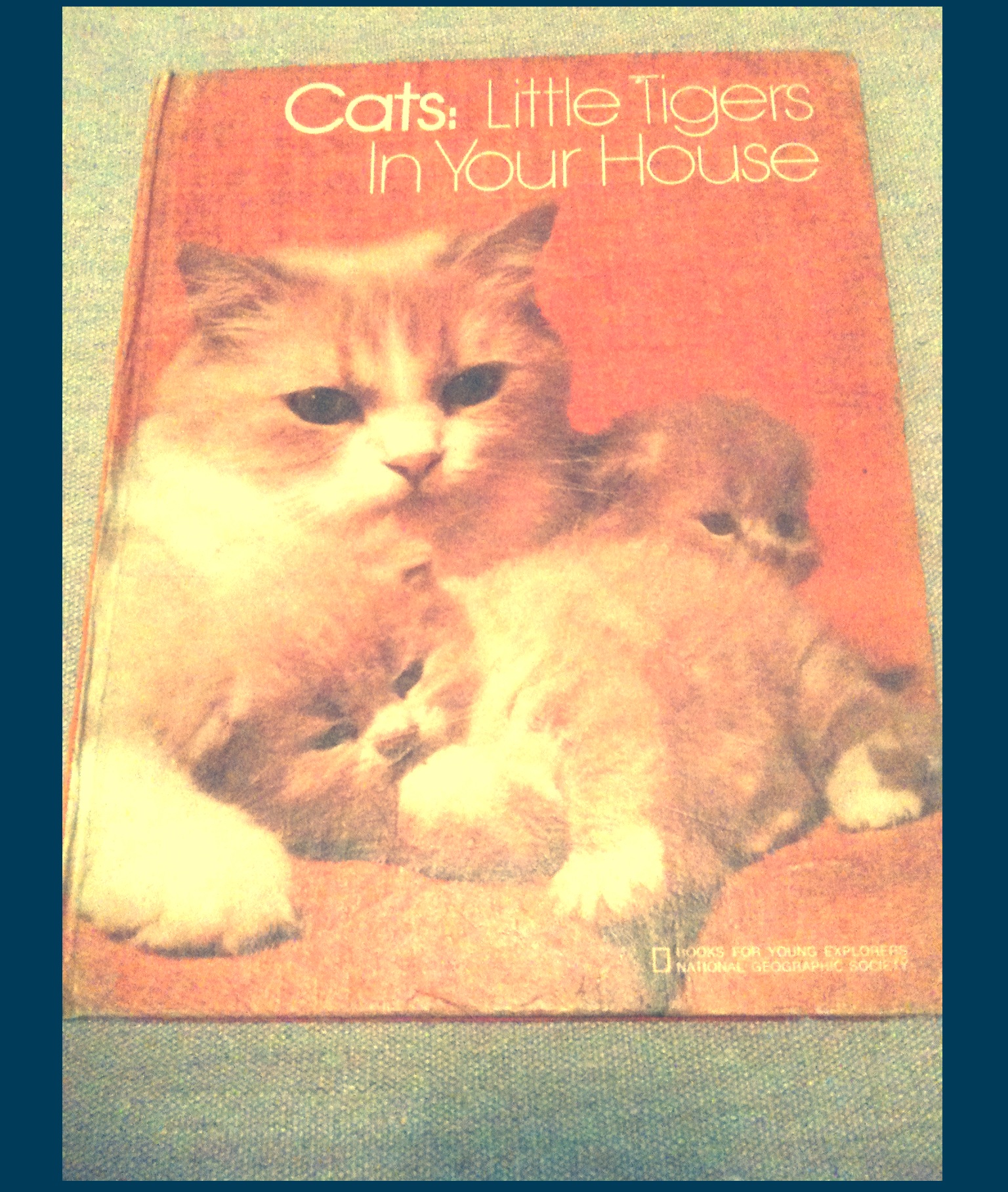
On Sunday, I posted this photo to Facebook, noting that I had owned this book since I was 2 1/2 years old.

It took a friend approximately three minutes to name two of the kittens (Paddy Paws and Toddly) featured in the tale. He also quickly found a link to the series, titled Books for Young Explorers, on LibraryThing.

Looking at the inscription date — December 1974 — and considering the fact that the book was from a branch of the family with whom we did not usually exchange Christmas gifts, I can only reason that this book was offered to me as a consolation prize after my little brother was born.

A kitten would have been more appreciated.

My real question is how I didn’t manage to obtain this entire series. Because a quick look at some of the titles (Amazing Otters, Animals of the High Mountains, Animals that Build their Homes) tells me that this series was written specifically for me and my kind.

It’s made it through a lot of moves and book purges, I think because I love the title so much: Little Tigers in Your Home. I also must admit, however, that flipping through page after page of kitten photos never gets old.

I finally found the highest use for Biscoff Spread, often called “Europe’s alternative to peanut butter” (I thought that was Nutella).

Biscoff Spread, which consists of Biscoff cookies smashed up with oil and a few other ingredients, is enjoyed on everything from apple slices to crackers to, well, spoons. I had been reading about it for a while, but when my sister-in-law sent a jar my way earlier this year, I found myself ill-prepared to experiment with it. I spread it on a couple of Ritz crackers and a few slices of banana, but I was underwhelmed — cinnamon-filled and smooth, it was tasty, but it didn’t “wow” me.

This past Saturday, however, after spending two hours making cat food (Haggerty weekends are OFF THE HOOK, y’all), I found myself looking for a snack. The most ridiculous thought crossed my mind: What if I put some of that cookie spread on a chocolate sandwich cookie? (And yes, I totally mean Oreos, only what I had was Publix-brand chocolate sandwich cookies, which are pretty much just as good and every few months you can get them for a penny on Wednesday with a $10 purchase and a coupon from the Huntsville Times.)

And just like that, I knew that I not only had come up with a ridiculous snack pairing, but that I was also totally going to try it.

Sorry. The most delicious pairing for Biscoff Spread is not a delicate, low-calorie rice cake, or a good-for-you chunk of fruit, or even a low-fat cracker. No. The item onto which you should spread this high-fat, high-sugar concoction? A cookie.

That’s right: Put some cookie spread on a cookie. Double the cookie-ness of your snack. Risk tearing a cookie-shaped hole in the snack-time continuum.

Just try it.

Despite a general aversion to most things mathematical, I sometimes have a thing for numbers.

(And before anybody goes all “girls can do math, too” on me, I didn’t say I wasn’t any good at math. I made a B in college calculus, and I totally rock a balanced checking account. I CAN do it, but sometimes I’d rather not calculate the square footage of my back yard. You know how big my back yard is? TOO big.)

I have to be careful with numbers in the fitness arena, however, lest my “thing” for them becomes an obsession. I don’t weight every day, or every week, usually, as I’ve learned that constant monitoring isn’t very helpful OR very accurate.

Cue my surprise earlier this week, when, after a two-month regimen of running and relatively healthy eating in addition to a slightly downscaled weightlifting routine, I found that I had actually GAINED two pounds since February.

Nothing fits more tightly, mind you, and at least one pair of jeans actually seems a bit looser in the upper leg area. I can only conclude that my body packs on muscle more efficiently than I knew it could.

More muscle in the same amount of space — or slightly less space — equals two pounds. Fine. But it’s not exactly making me feel dainty.

Then again, maybe it’s simply time to redefine the definition of “dainty.” Or simply forget about feeling dainty in favor of feeling strong.

Katie is the only tiger that Tigers for Tomorrow has purchased (the group always has to raise money for the transport and care of each animal, but usually doesn't pay a fee for the animals). Katie was bound for an exotic animal auction, and some of the bidders were rumored to be buying animals for canned exotic animal hunts.

Several months after I moved to Huntsville, I cut out a picture of a woman holding a tiger cub and secured it to my refrigerator. The accompanying newspaper article described a relatively new exotic animal preserve called Tigers for Tomorrow, which rescued animals from private owners, carnivals and canned hunts.

Five years later, I finally got around to visiting the rescue preserve, located in Attalla, Ala. — a mere two-hour drive from Huntsville. The husband and I spotted an announcement about special spring break educational tours and planned a quick day trip.

Wilbur McCauley, Director Of Animal Care and Operations, led a couple dozen visitors around the preserve the day we arrived, sharing information on the characteristics, instincts and natural habitats (or, more likely, the shrinking natural habitats) of several animals.

Tigers for Tomorrow houses more than just tigers — you’ll find lions, bears, cougars and wolves in addition to smaller animals such as goats, miniature horses, emus and even a zebra.

McCauley explained that each animal has its own unique personality, and none of them illustrated this better than Yonah, a grizzly bear that arrived at the rescue when he was 6 months old. When Yonah realized that McCauley wouldn’t be coming into the enclosure with him, the young grizzly started making a growling/purring noise that McCauley identified as a self-comforting behavior. A self-comforting behavior that sounded like a two-stroke engine.

Yonah was used for promotions in North Carolina until he got too big (he'll eventually weigh up to 800 pounds). Yonah, which is Cherokee for "bear," doesn't know how to socialize with other grizzlies because he was raised alone as a pet before he was rescued.

Make no mistake: This is an educational tour, not a zoo visit. You’re going to learn about the histories of several of the rescued animals. These are not happy stories, but they have happy endings.

A friend asked me if Tigers for Tomorrow was sad. My reply was that it’s sad that a place like this has to exist, but the preserve itself isn’t sad at all. The animals enjoy large enclosures, an appropriate diet and loving caretakers. There’s no evidence that the animals are uncomfortable or unhappy; one black wolf circled the perimeter of its enclosure almost obsessively while we were nearby, but McCauley assured me that this behavior was the temporary result of encountering such a large crowd of people.

Tigers for Tomorrow is a 501(c)(3) non-profit organization with a board of directors that guides the rescue’s decisions. This rescue is not in danger of becoming what I would call a “hoarding” or “collecting” rescue; the group only adopts a new animal after sufficient funds are raised for the transport, housing and care of that animal.

Kazuma was the group's most expensive rescue. He was part of a circus near Antigua, Guatemala, when CONAP (the same as our U.S. Fish and Wildlife Service) informed the owner he had to improve the lion's conditions (he was living in a small cage). The owner ran away with the lion, but CONAP eventually found him and moved Kazuma to La Aurora Zoo to await rescue.

One of the factors that prompted me to take advantage of the spring break tour promotion was the knowledge that I would be able to take photographs. McCauley explained that visitors on regular “walkabout” tours of the reserve are no longer allowed to take photographs because some people were tossing items at the fences to get the animals’ attention for better pictures.

Seriously? People visit a wildlife preserve and aggravate the wildlife? I’m not shocked, but I am disappointed.

Spring break tours are running through April 12 (I know, short notice). Gates open at 1 p.m., and the tour begins at 2. Children can feed the animals in the animal contact area (goats, calves, emus, etc.) before the tour. Tour admission is $10 for ages 3-11 and $15 for ages 12 and older. (Tours are usually $25 a person).

Head to the Tigers for Tomorrow website for the most up-to-date information on hours, tours and prices (hours are limited, and the preserve isn’t open every day). And GO. You won’t be disappointed.

Tigers for Tomorrow raised the money to fly Kazuma from Guatemala to Atlanta, then drove him to the rescue facility. He's still working to develop his leg muscles, which had atrophied after living in a small cage when he was part of the circus in Guatemala.

At some point, the husband started calling the organization Tigers from Tomorrow, as in tigers from the future. Because who wouldn’t want to meet tigers from the future? That would mean that there are tigers IN the future, after all.

I’ve finally become familiar with the terms thinspo and fitspo.

Short for thinspiration and fitspiration, both describe inspirational images of — let’s face it — women who are skinnier than most of us. Thinspo images are sometimes associated with eating disorders (you inspire yourself to get thin by looking at them and feeling ashamed of your own body). Fitspo is supposedly thinspo’s safer, healthier cousin; these women aren’t bone-thin, after all, they’re muscular and fit. I mean, come on. They’re wearing GYM CLOTHES.

Thanks to Pinterest, thinspo and fitspo images have flooded the Internet over the past few months.

Haven’t seen any? I don’t know how that’s possible, but I’ll wait here while you check out thinspo and fitspo on Pinterest.

Many of the women in these photographs present us with new variety of unobtainable physical ideals; they’re underwear models topped with a thin veneer of musculature, with nary a hint of cellulite. Sometimes they simply appear to be skinny ladies standing around in their underwear, without even a pretense of any association with fitness.

One pin features a topless woman, photographed from the back, lounging on a bed with her jeans halfway down her backside. Exercise is, apparently, exhausting.

I’m torn. I like images of strong women because I WANT women to be strong. But I also fear that these images may trigger shame and self-hatred in women who don’t live up to these physical ideals (in other words, most of us).

Several bloggers, including Helena Handbasket (whose post alerted me to this controversy) and Virginia Sole-Smith have expressed similar reservations about fitspo. On The Great Exercise Experiment, Charlotte Hilton Andersen says fitspo may simply be “thinspo in a sports bra.

To obtain the musculature of many of the women in these photographs, you’d have to follow a very strict diet and work out A LOT. I don’t mean five times a week instead of four, I mean every day, possibly for several hours. (I used to know a woman who looked like a fitness model, and she exercised three hours a day and would never go out for dinner or drinks because she didn’t dare deviate from her special diet. BO-RING.)

Admission time: Fitspo images make me feel bad about my abs — I wish that they were rock-hard and better defined. My abs are NOT a trouble spot for me, so you can just imagine what such imagery makes me think about my thighs, which feature — gasp — cellulite. Cellulite that didn’t even go away when I went through a dangerously skinny post-tonsillectomy phase in college. (I got down to a size 4, which today would probably be a size 0. You can, indeed, be too thin. Maybe not too rich, though.)

That said, my legs are AWESOME. Running combined with a healthy regime of squats and other muscle work has left them strong and capable. They’ve just got a little bit of padding up top.

This is the kind of attitude that I worry slips away when we see fitspo images. We can’t be content with “look at the awesome things my body can do” when the mantra “it’s not good enough if I don’t look like that” is running through our heads.

In the introduction to Eating Our Hearts Out, a collection of women’s personal accounts of their relationship to food, Lesléa Newman writes, “Our culture makes it nearly impossible for us as women to have a healthy, easy relationship with food. On one hand, we are supposed to be the nurturers of the world, perfecting recipes to delight our families, and, on the other hand, we are supposed to deprive ourselves of these delicious meals in order to look the way our society deems it best for us to look, which can be summed up in one four-letter word: thin.”

I argue that we also have an uneasy relationship with fitness. For many, the simple act of challenging the body is not enough; exercise without dramatic transformation toward perfection — thinness — is simply pointless. This all-or-nothing attitude has to be the root cause of the many January fitness programs that are abandoned by March.

It’s exhausting, really, this constant obsession with food and calories and carbs and measurements and weight. Honestly, what more could women accomplish if we weren’t so completely preoccupied with the scale and the tape measure?

If fitspo inspires you, pin away. Just make sure it’s inspiring you to make yourself stronger and healthier, and not prompting feelings of self-loathing.

In “A Weight that Women Carry,” an essay in Minding the Body: Women Writers on Body and Soul, Sallie Tisdale writes, “In trying always to lose weight, we’ve lost hope of simply being seen for ourselves.”

Similarly, in mirroring ourselves against the perfection found in fitspo images, we risk being unable to simply love ourselves and acknowledge the positive things about our wonderfully imperfect bodies.

Well, maybe not YOU.

But some of our Facebook friends are making us cringe when we see that we have comments to review. Here are the top 5 Facebook commenting blunders that I’ve noticed seem to be on the rise:

  1. Adding needless drama and stress in the form of one-upmanship. Your FB friend may complain of recurring back pain, but YOUR brother had long-term back pain that was finally so disabling that he couldn’t walk anymore. Yeah, your FB friend’s headache is PROBABLY related to allergies, but that’s what your uncle thought before he died of a neuroblastoma three weeks after diagnosis. You’re not only asking your friend to worry needlessly, you’re managing to focus the attention on YOU. Way to go, Narcissa.
  2. Offering unsolicited advice. Your FB friend announces that he’s found a diet and exercise plan that works for him? No better time to tell him how much you love this OTHER diet plan and how it has ALWAYS worked for you. Your friend has made the painful decision to have his dog put to sleep? Why not tell him he should TOTALLY reconsider because your cousin’s dog was misdiagnosed and got better after a few weeks with another vet. If someone has thought long and hard about a tough decision or lifestyle change and you insist on offering unwanted, contradictory information, they’ll remember that more than any helpful advice you’ve ever given them.
  3. Ignoring other comments and repeating useless, damaging information (see Nos. 1 and 2). If someone has already said exactly what you’re going to say in a comment, and your FB friend has responded with a “thanks but no thanks” reply, you’re going to look like the biggest idiot in the village when you make the same comment. If you just can’t bring yourself to read all the previous comments to ensure that you’re offering unique and/or reassuring information, then you’re just adding white noise to the conversation anyway.
  4. Saying something unforgivably filthy. As a former newspaper copy editor, I admit that my tolerance for inappropriate humor is a bit higher than normal. And I realize that Internet discourse is a little rougher than interoffice email, depending on the office. But when you say something so obscene that I have to drop whatever I’m doing at the moment to log in and delete your comment from my timeline, you’ll never see anything I post again.
  5. Starting arguments with other commenters just for the sheer egotistical joy of outmaneuvering someone intellectually. This leaves the “losing” commenter with much less of an inclination to ever comment on your mutual FB friend’s wall again. Unless this commenter is someone with whom you engage in intellectual horseplay on a regular basis, save the academic arguments for your own posts.

This month’s Rocket City Bloggers’ shared carnival topic — “your favorite tool” — was a gimme.

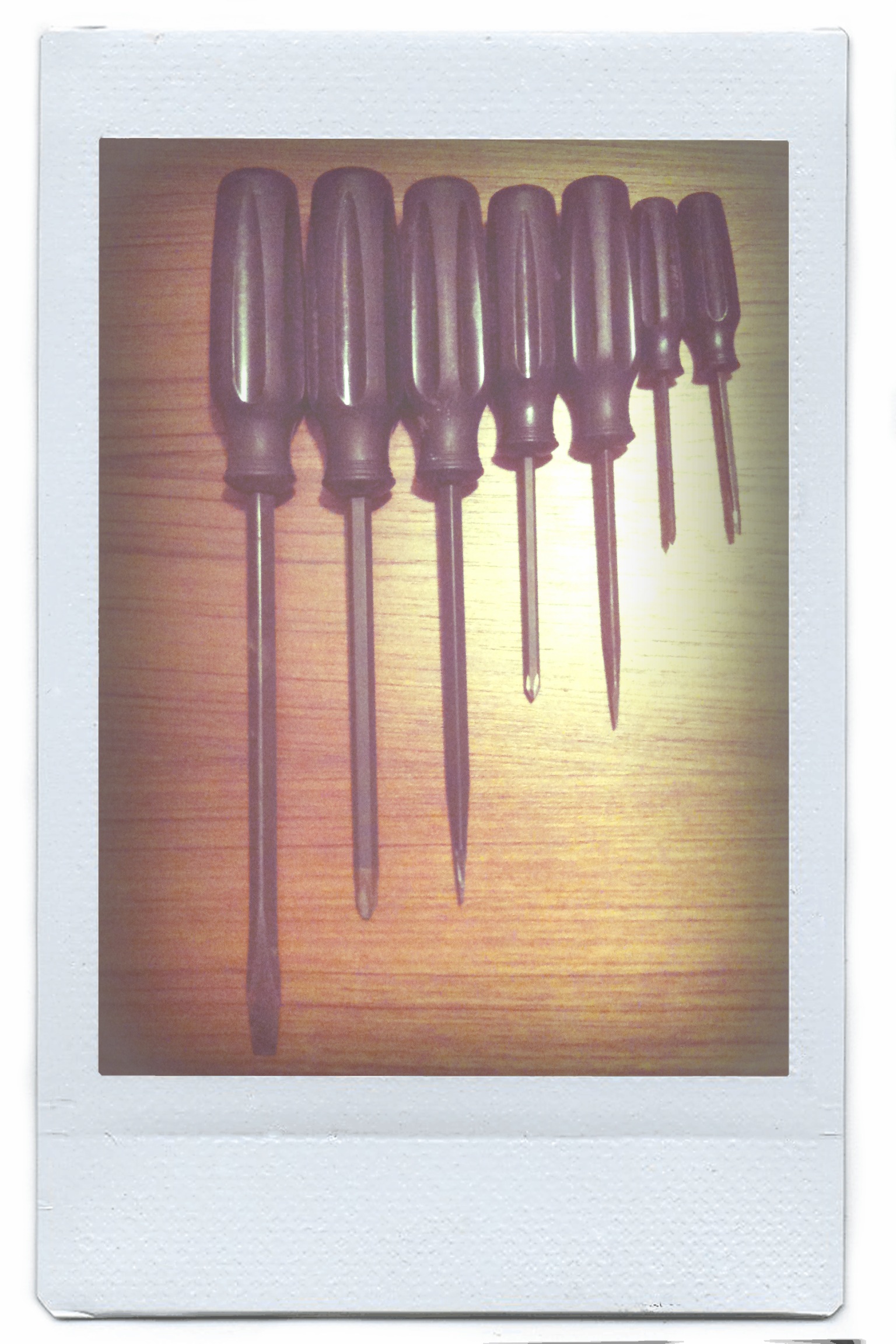
It’s the set of screwdrivers that my grandmother gave me for Christmas the year after I got married.

One of the first realizations I had after moving in with the husband was that our organizational styles differed. He could live with items in any number of places, whereas I enjoyed finding the same items in the same places time and time again.

Screwdrivers, for some reason, were an early ongoing issue. I would find them on the kitchen counter, under a bathroom sink, on a bookshelf or in the car. Anywhere but the toolbox. And I would NEVER find the model I actually needed. Sure, it was nice to know that the medium Phillips head was on the end table, but that knowledge wasn’t helping me tighten the flat-head screw on the top bookshelf.

My grandmother heard my laments and came to the rescue. Christmas morning, I was the envy of all the men in the room, with my full set of Craftsman screwdrivers (complete with a bonus pair of RoboGrip pliers that have since met their demise).  The tools were packaged in a vinyl organizer, so it was easy to keep track of them, and keep track I did. I all but made the husband sign a checkout card when he needed to use one for a project.

The vinyl organizer disintegrated a couple of years ago, so the screwdrivers now reside in a plastic box that formerly housed jewelry. I had to steal back the favored medium Phillips head from the husband’s office for this photo, so obviously my efforts to keep them all in one place aren’t always that effective.

It would be too simple to say that these screwdrivers are my favorite tools because my grandmother gave them to me. I mean, she made sure I had the BEST screwdriver set that she could find. What could have been a throwaway joke gift was, instead, a well-planned purchase that I’ve used time and time again.

The woman who had given me a toaster and a mixer at my wedding shower was perfectly content with the idea of her granddaughter wielding a screwdriver in the name of DIY. Awesomeness personified.

Zenni Optical may be the most important company I’ve discovered in a long time.

The three pairs of prescription glasses pictured above? They cost me a total of $28.75, including shipping.

Utterly ridiculous, right? The prescriptions must be wrong, or the frames must be ready to fall apart, or the lenses must be overly susceptible to scratches.

Nope. Every pair is comparable, in every way, to the last pair of glasses I purchased for $300-plus. A pair of glasses, I might add, that never quite fit correctly, despite numerous follow-up visits for adjustments, and featured lenses with a disorienting flare effect despite the addition of a recommended coating.

Zenni ships its products direct from China to California, then to customers. If the price difference were less dramatic, say, $250 for glasses I would pay $300 for locally, I probably wouldn’t bother ordering from Zenni. But the site lists perfectly fashionable and functional frames starting at $6.95 a pair (the price of each pair of frames pictured above, in fact).

I can only assume that this means I have been paying ENTIRELY too much for frames, even the supposedly inexpensive models sporting no name brand. I would hazard a guess that some of the same frames that Zenni carries probably get stamped with a designer label before being marked up in price some 2000 percent and going on sale here.

The one thing that I’ve always hated about glasses (and the thing that has prompted me to wear contact lenses, no matter how uncomfortable they can be at times) has been the one-pair-at-a-time problem. Glasses are so expensive that you feel like you only get to have one good pair, with maybe an old pair as backup.

Even the cheapest frames and lenses are going to set you back $200, an amount that isn’t prohibitive, necessarily, but has always made me hesitate to purchase more than one pair at a time.

I’ve always wished that glasses were like earrings: I want a selection to match moods and outfits.

Zenni has made this wish come true, turning glasses into fun, affordable accessories.

Wait until you see me in the blue pair.

This loaf of cinnamon sugar bread almost never came to be, which would have been quite unfortunate, because it was a thing of perfection, with a crunchy top and soft interior laced with more than a mere hint of cinnamon sugar.

The first time I tried the recipe, the top wasn’t crunchy, and the interior was a wet, soupy messy of cinnamon sugar and raw batter. It fell apart coming out of the loaf pan, and I had to cut it into pieces before bringing it to the office to save myself the embarrassment of co-workers trying to cut/scoop servings for themselves.

The concoction’s only saving grace? It was, beneath the disfigured clumps and raw batter, utterly delicious.

The original recipe called for all of the cinnamon sugar mixture (a full 1/3 cup of sugar and 2 teaspoons of cinnamon) to be sprinkled in one layer on top of half of the batter, then topped with the rest of the batter. The cinnamon sugar mixture seems to have liquefied and prevented the batter immediately surrounding it from baking completely.

I decided to give the recipe one more chance, figuring that if I could make smaller layers of cinnamon sugar, maybe the batter would have a chance to cook more evenly.

I didn’t get the chance until this weekend, when I babysat my nieces while my sister-in-law had a much-deserved girls weekend out. Given my ineffective Barbie doll skills (the girls got pretty upset when I couldn’t remember the names of the dozen dolls NOT named Barbie) and the cold weather preventing us from easily pursuing outdoor, more tomboyish activities, I decided that a baking project was in order.

Part of the reason I wanted this recipe to work was its ease of preparation: You literally stir seven ingredients together for the batter and then layer it in the loaf pan with cinnamon sugar. No mixer. No sifting. No melting.

After having my charges stir the batter and shake the cinnamon sugar mixture together thoroughly, I poured what I figured to be about a third of the batter into the bottom of the greased and floured pan. I then had my nieces spoon about a third of the cinnamon sugar over the batter. I added another layer of batter, then almost all of the cinnamon sugar save for about 2 tablespoons. I added the rest of the batter, then sprinkled on the rest of the cinnamon sugar.

50 minutes in the oven plus 10 minutes on the wire rack and the loaf slid right out of the pan. After allowing the bread to cool for about 20 more minutes while watching Scooby-Doo (the 2002 live-action version), we had cinnamon bread and hot chocolate out of my childhood Tupperware tea set (now theirs).

Babysitting perfection.

The original recipe came from A Whisk and a Prayer via Pinterest.

Cinnamon Sugar Bread

Adapted from A Whisk and a Prayer

  • 1/3 cup white sugar
  • 2 teaspoons ground cinnamon
  • 2 cups all-purpose flour
  • 1 tablespoon baking powder
  • 1/2 teaspoon salt
  • 1 cup white sugar
  • 1 egg, beaten
  • 1 cup milk
  • 1/3 cup vegetable oil

Preheat oven to 350 degrees. Lightly grease a 9×5-inch inch loaf pan (I also cut a piece of parchment paper to fit on the bottom for extra non-stick protection). Stir the cinnamon and 1/3 cup sugar together.

In a large bowl, combine flour, baking powder, salt and 1 cup sugar. Add the egg, milk and oil. Stir until just moistened.

Pour approximately a third of the batter into the loaf pan. Sprinkle with about a third of the cinnamon sugar. Top with another third of the batter, then almost all of the remaining cinnamon sugar. Pour the rest of the batter in the pan and sprinkle the rest of the cinnamon sugar on top.

Bake in preheated oven for 45 to 50 minutes, or until a toothpick inserted into center of the loaf comes out clean. Let the bread cool in the pan for 10 minutes before removing it to a wire rack to cool completely.

The original recipe advises you to wrap the loaf in foil and let it sit overnight before slicing. If you can endure the scent of freshly baked cinnamon bread wafting through your home without cutting a piece off until the next day, then go for it. If not, enjoy your snack today AND tomorrow.